Village People
Curious about the living traditions of Slovakia, Andrew Cronshaw takes his notepad and camera to the tiny village of Šumiac.
We have European Capital of Culture, and Cities of Culture; I’d like to propose Villages of Culture. When I’m interviewing roots musicians in any country, among the first questions are “Where do you get your material? Are there living traditions? What happens in the villages?”
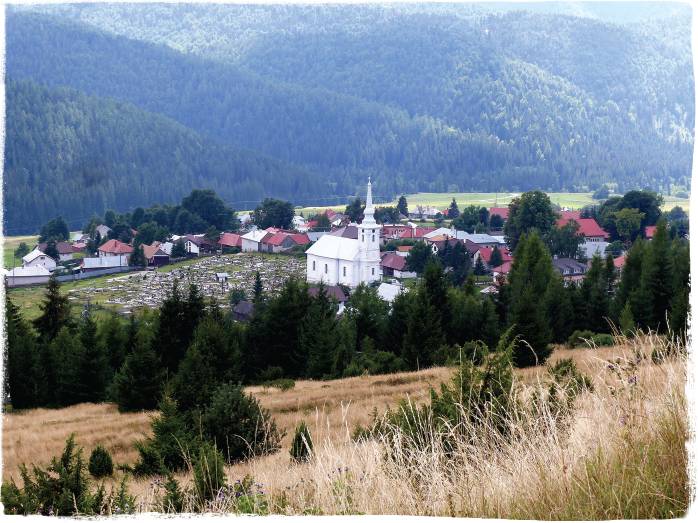
Dajana Margetová is a young Slovak traditional singer who lives, as her family has done for generations, in Šumiac (pronounced ‘shoomiats’), a village full of a lovely variety of wooden houses around a white-painted church in a green valley of the Low Tatras in north central Slovakia.
She sent me a Facebook message in 2014, with a rough video of a short concert of the experimental music she and others had done in the village’s community centre, involving live-resampling their female vocal trio. I was excited – it reminded me very much of a recording that’s been a big influence on me, Svetozar Stracina’s impressionistic traditional music tape-edit soundscape Pastierska Hudba on an all-time favourite LP, Prix de Musique Folklorique de Radio Bratislava 1974.
Dajana’s subsequent messages and links told me about musical and seasonal life in the village, with lots of very strong and wonderful female and male polyphonic singing, dancing, a summer festival, traditional customs including weddings, processions, sledge races, ornate traditional costumes, folk crafts, art, photography, and small-scale themed film festivals. A village of culture, Šumiac seemed to be, where people celebrate where they live and make things happen, all year round.
Dajana invited me there in August 2015 to find out more and do a bit of collaborative playing at their festival, Šumenie.
It’s a small village, and the festival, begun seven years ago as a photographic competition, is still small but gradually growing. It centres on the building housing the community hall and the primary school with an outdoor stage out back. On the village square in front of it tables are set out with food and local crafts, including those of a maker of fujaras, other Slovak flutes and, er, didgeridoos, and a maker of livestock bells and traditional wide leather men’s belts. (Another villager, shepherd and musician Mikuláš Gigac, has been collecting animal bells from Slovakia and the world for 50 years and has turned the ground-floor rooms of his home into an amazing private museum displaying thousands of them and some Šumiac costumes; he also has a collection of local songs, and when we visited was making the local spaghetti-like korbácik string cheese.)
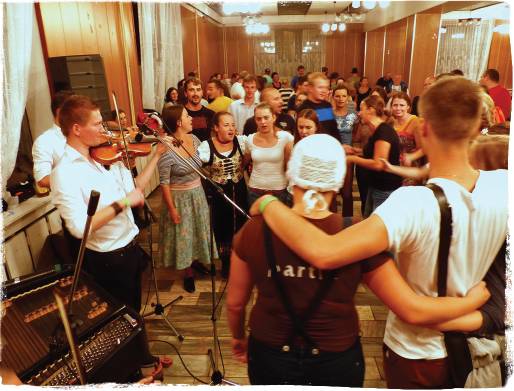
The after-concert dance
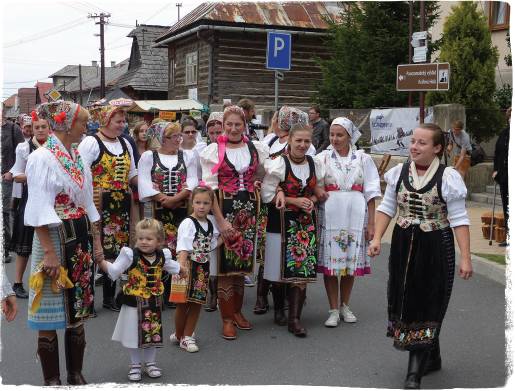
The start of the Kacierina procession
Dajana’s family, and their Mons Regius organisation, are central to the festival and much else, Dajana running the musical part, sister Dominika the visual art aspects and eldest sister Denisa the photographic side from which the festival sprang. Their mother Anna runs the cosy Margarétkovo café and health food shop on the square, and their father Ján energetically backs them all up. Grandmother Mária, seeing that the traditions she lived and loved were dwindling, founded many years ago the folklore group which still has a strong role in village life. Mária, Dajana and Dominika and aunt Anna Margarétka also sing together as the quartet Margetky.
Šumenie festival happens on Friday and Saturday. During the day there are art and photographic exhibitions, workshops and discussions, and on the Saturday afternoon there’s the dance-song-procession called Kacierina. Formerly in the spring when the women went to the fields, in the last couple of years it’s been revived as part of the festival: a procession of women, many in traditional costume, process up the street singing, joining hands in pairs to make arches through which those at the back run so that the front of the procession is constantly renewed. When they reach the square they dance in circles, singing. Šumiac is noted for the strength and volume of its singing; both male and female, but at this year’s festival mainly female.
In the evenings there are concerts on the outdoor stage. The Friday concert opened with young singer-songwriter and keyboardist Katka and her band; she was followed by the experimental music project, featuring singers Dajana and Dominika Margetová, Patrícia Bošelová, and very fine male singer Štefan Štec from Košice, with Matej Haász laptop-live-sampling their voices, whistles and bells into a soundscape, with video projections. Polish duo the Magic Carpathians and I were invited to join in. Finally Slovak African drums and dance group Bakuruba warmed up the late-evening mountain chill, their set developing into an all-comers dance-jam.
On Saturday the Warsaw Village Band made it over the Tatras for, surprisingly, their first ever performance in Poland’s southern neighbour Slovakia. Before them came the very fine singing of Margetky, plus the trio of Barbara, Anicka and Saška Matáková from Cadca, north-west of Šumiac. They were joined by dancers Peter Hrabovský and Martina Takácsová and accompanied by the fiddles, viola, cimbalom and bass of fiddler and singer Michal Pagác’s band from Dubnica.
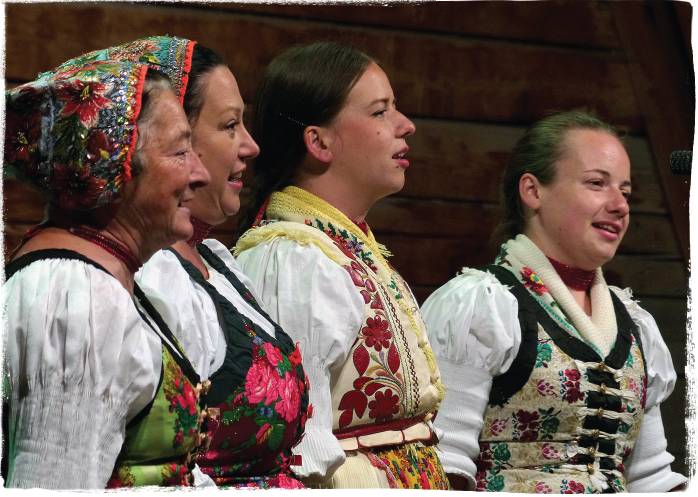
Margetky (L to r: Maria, Anna Margaretka, Dominika, Dajana)
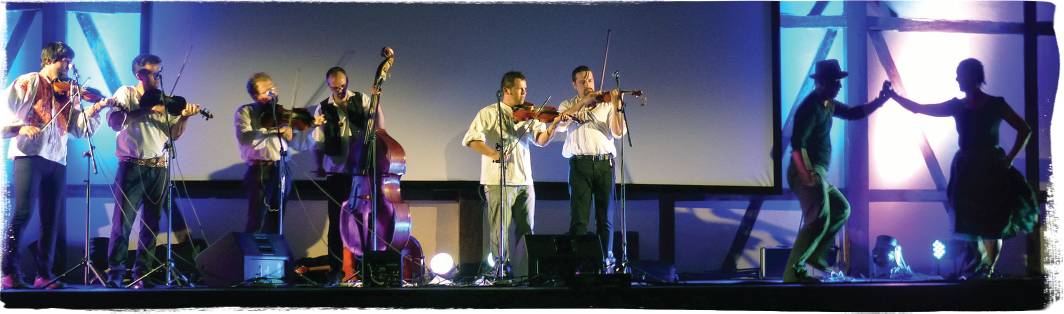
Muzicka at EtnoKrakow
At the after-party in the community hall the Pagác band played on for dancing, and for the indefatigable unison and harmony singing. There’s a remarkable custom in the region in which a person who wants to sing a particular song will go up to the band and, giving voice with great gusto and encouraging gestures, demand it slows down and follows in accompaniment; the rest of the assembled company join in, before the band swings back into a faster dance tune. The singing, arms round shoulders, and swirling dancing went on far into the night.
Next morning the band came to the Margeta family house for a late breakfast, and I asked them whether this had been a special gig for them, or just a normal night’s work. It seemed that, though it was a good one, they play at similar village dances, and for weddings. Bands are still very much in demand because, unlike in most parts of present-day Europe, many Slovak villages have celebrations or little festivals (and there’s the big central Slovak folklore festival at Detva, in fujara heartland to the south of Šumiac), and many weddings are still traditional-style at least in part, and traditional costume in its varied regional styles is even becoming more fashionable, for women at least.
Dajana describes one of these present-day weddings. “The procession meets in front of the groom’s house, and the musicians start playing, and then they follow the procession towards the bride’s family’s house, and then to church where they play outside. Then everyone goes to eat, and there’s dancing and all that. Until midnight the bride wears the traditional hairband, but after midnight she gives it to her husband, and puts on the traditional embroidered hat, and becomes the wife.”
David Sladek, who is acting as my excellent interpreter when necessary, tells me, “The way of singing in Šumiac – the hard voice – that’s the traditional way, but across Slovakia most of the bands try to style themselves into more modern ways. But there are bands who follow and study traditional ways of playing.”
One such is the Bratislava fiddles and vocal band Muzicka, formed 30 years ago by city musicians exploring and taking up the music of the villages. They weren’t in Šumiac, although they’ve played there in the past, but I’d seen and been impressed by them, augmented by a pair of the dancers they often work with, in July at EtnoKraków in Poland, and had a brief chat with prime mover Tomás Brunovsky.
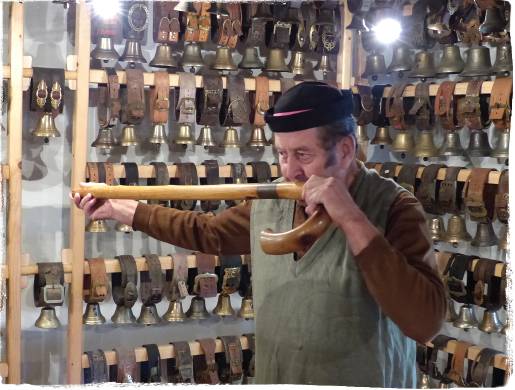
Mr Gigac with just a few of his bells, and a walking-stick whistle
A track from their recent album Destilát was on the fRoots 55 compilation. So, to follow up, on my way through Bratislava I met up with two members who could spare time from their day jobs: kontra (viola) player Michal Brdársky and bassist Peter Obuch.
“The initial engine was some old recordings that somebody from the band at that time had available. And the other members kind of fell for it. I think especially Tomás Brunovsky, who you talked to. He’s not the leader in a primary sense, but he pulls the whole thing together; he often chooses what he likes from the music, what we should practice. We play music from across Slovakia, but I think the best of what we do is from the north and centre”
The usual question again: where do they get their material… the villages?
“We mostly use recordings. Because not too many really traditional bands are still alive. But there are a lot of recordings, from all regions of Slovakia, that we have access to. You can still meet a couple of singers, old ones, and also a couple of musicians that are still… not always playing, but still alive. So they can show you, or at least tell you, how it was. But there are really not many people still living who would be interesting for us. We as Muzicka are focused on older sounds, for example using major chords in minor songs. So that’s why the sources for us would be only somebody who is older and used to play in the middle of the 20th Century. Because, although there are people in villages who sing and play, it’s often influenced by something new. They have a musical education and…”
I asked what they consider the identifying sounds of Slovak music – apart, of course, from the voice. “We could put it in two categories: solo instruments and bands. Solo instruments – those are mostly from the highland regions: various horns, many sorts of pipes such as fujara, and bagpipes. That’s in the older sort of music; the newer would be stringed instruments – fiddle bands, dulcimers. And, newer than that, brass. And the instrumental music tends to be newer than the songs. In the old times not so many people had instruments – they sang and danced and used drums.”
Walking down Šumiac’s main street, observed from the houses’ yards by goats, gobbling turkeys and barking dogs, one comes into the part where the village’s Roma live. As in most of central and eastern Europe, Slovak Roma are no longer itinerant, partly because the Soviet regime didn’t allow it, though most had settled before then. But they usually live alongside rather than among the general community. In Šumiac all the children go to the same primary school, and everyone uses the community centre – there was a Roma wedding there on the day I arrived – but there was little Roma involvement in the festival. (But then, consider the demographic of British folk festivals…) Šumiac isn’t a hotbed of Roma musicians nowadays, but the fine and long-established Roma Pokoš family vocal and string band Pokošovci, while now based in Valkovna, originated there.
At EtnoKraków I’d seen the moving documentary Cigarety A Pesnicky (Cigarettes And Songs) about the ‘After Phurikane Gila’ project which brought together six Roma singers from villages in east Slovakia to record together, in conjunction with some top non-Roma musicians. The screening was followed by an even more moving performance by two of the six, the sweet-voiced harmonising siblings Martinka and Ferko Duda, who are both blind and very physically disabled; they had to be carried onto their chairs on the stage. In Bratislava Jarmila Vlcková took me to meet project initiator Jana Belišová, and helped with translation.
Jana tells me “There aren’t many performances like in Kraków; mostly they sing together with a type of wedding band, with other musicians, that plays around where they live, and for that they sing what they think the audience expects. But if Roma people sing for themselves it’s more about what they really feel, more about them. I’m trying to persuade them that a concert audience is interested in what they sing for themselves, because it’s probably more powerful.”
Jana was born and raised in a village in east Slovakia, where there are a lot of Roma people, who are generally very poor. (Roma string bands come mostly from central Slovak villages, such as Hrochot and others; in the east few can afford instruments and it’s mainly singing.) Despite quite a deal of tension between ‘white’ and Roma, and her parents asking her not to play with Roma kids, she wanted to have some connection with them. She started to study ethnology and music science, and went to the villages and began to record mostly Slovak folk music.
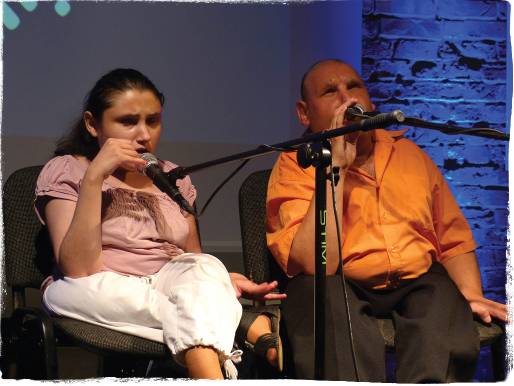
Martinka & Ferko Duda
She felt, though, that the music of the Slovak folk environment is almost all collected, so didn’t feel there was space for her to do any more with it. But when she encountered Roma music, and saw how even four-year-old children sang emotionally, it was very touching for her. She made Roma friends, and realised that the old songs were being sung less and less, and that there was minimal interest in this music. She felt it wasn’t championed enough, and that was what she’d like to do. That was fifteen years ago. She managed to get a grant to enable the making of the CD of field recordings Phurikane Gila – Ancient Romany Songs, released in 2002, and the beautiful book of the same name published in 2005, with photos, the lyrics of their laments and vivid descriptions of the people and how they live.
“And then I couldn’t stop! There were more and more projects – songs for kids, dance songs, Christmas songs… I became tired, and wanted to stop several times. But then I said to myself ‘OK, who will do it if you don’t?’ So it continues.”
I asked about the emotional stress of working with these very poor people’s music but being unable to help them substantially, for example with money, to change their situation.
“You know them personally and they call you needing help. So I tried a few times to help them, and found work for one of them. But it’s necessary to make a line between the work and private life. Which can be very hard. I’m an ethnomusicologist, and sometimes can work like a manager, and can sometimes help as a person, but our organisation, Žudro, isn’t for social work, it’s made for another purpose, and I have to let the people know that there are some kind of rules, and what is the intention of work.”
For this opportunity to glimpse just some of Slovakia’s rich living traditions, and much help and hospitality, thanks to Dajana and family, and Jarmila Vlcková and family.